How to Generate Leads for Small Businesses: 15 Proven Strategies to Grow Your Sales

Updated: Sep 5

Struggling to find a consistent flow of new customers? Learn how to generate leads for small businesses using practical, cost-effective strategies that can build your pipeline and increase sales.
For any small business, getting a steady stream of potential customers is essential for growth. You may have an excellent product, competitive pricing, and a professional website, but without the right prospects entering your sales funnel, growth can become unpredictable.
The good news is that small businesses don't need massive marketing budgets to generate quality leads. With the right small business lead generation strategy, you can identify your ideal customers, reach them through the right channels, and turn interested prospects into paying customers.
In this guide, we'll explore the most effective ways to generate leads for small businesses and explain how you can build a repeatable lead-generation process.
What Is Lead Generation for Small Businesses?
Lead generation is the process of identifying and attracting people or businesses that may be interested in your products or services.
A lead can come from many different sources, including:
Your website
Google search
Social media
LinkedIn
Email marketing
Online advertising
Referrals
Networking
Content marketing
Lead-generation services
The objective isn't simply to collect as many contacts as possible. Effective small business lead generation is about finding prospects that are relevant to your business and have a genuine possibility of becoming customers.
A smaller number of highly relevant prospects can be significantly more valuable than a large database of unrelated contacts.
Why Is Lead Generation Important for Small Businesses?
Large companies often have dedicated marketing and sales departments. Small businesses, however, usually operate with limited budgets, smaller teams, and fewer resources.
This makes having an efficient lead generation strategy even more important.
A consistent lead-generation system can help your business:
Build a predictable sales pipeline
Reach new customers
Reduce dependence on referrals
Increase sales opportunities
Enter new markets
Improve customer acquisition
Identify high-potential prospects
Reduce wasted sales efforts
Create long-term business growth
Without a reliable source of prospects, your sales pipeline can become inconsistent. One month may be excellent while the next month produces very few opportunities.
The goal is to create a system that continuously brings relevant prospects into your funnel.
15 Effective Lead Generation Strategies for Small Businesses

1. Define Your Ideal Customer Profile
Before trying to generate leads, determine exactly who you want to reach.
Your ideal customer profile (ICP) should describe the type of customer most likely to benefit from your product or service.
For B2B businesses, consider factors such as:
Industry
Company size
Location
Job title
Revenue range
Business requirements
Buying behavior
Common pain points
Budget
Decision-making authority
For example, instead of targeting "businesses that need marketing," you could target:
Indian real estate companies with 10–100 employees that are actively looking for qualified property buyer leads.
The more specific your ICP, the easier it becomes to build a targeted lead-generation campaign.
2. Build a Targeted Lead List
Once you know your ideal customer, build a database of relevant prospects.
A good lead list can include information such as:
Full name
Company name
Job title
Phone number
Business email
Website
Industry
Location
Company size
However, accuracy matters.
A database filled with outdated phone numbers, invalid email addresses, or irrelevant companies can waste your sales team's time.
That's why lead research and verification should be an important part of your lead-generation process.
3. Use LinkedIn for Lead Generation
LinkedIn can be an effective platform for reaching professional decision-makers, particularly for B2B businesses.
Instead of sending generic connection requests to hundreds of people, identify prospects who match your ICP.
You can search for prospects based on:
Industry
Company
Job title
Location
Company size
Professional interests
Once you've identified the right people, engage with their content, establish a connection, and introduce your business when there is a relevant reason to start a conversation.
LinkedIn lead generation works best when personalization and relevance are prioritized over message volume.
4. Use Cold Email Strategically
Cold email remains an important channel for businesses looking to reach potential customers directly.
But successful cold email isn't about sending thousands of generic emails.
Start with a verified prospect list and create messaging around the specific problems faced by your target audience.
A strong cold email should generally be:
Short
Relevant
Personalized
Clear
Focused on the prospect
Built around one specific value proposition
Supported by a simple call to action
For example, instead of:
"We provide the best services at affordable prices."
Try communicating a specific business outcome:
"We help businesses identify verified prospects who are actively looking for their products or services."
The second approach gives the prospect a clearer reason to continue the conversation.
5. Create Valuable Content
Content marketing can help your business attract people who are already searching for solutions to their problems.
You can create:
Blog posts
Guides
Case studies
Checklists
Industry reports
Videos
Infographics
Webinars
Downloadable resources
For example, a real estate company could publish:
"10 Ways to Generate More Property Buyer Leads in India."
Someone searching for that information may already have an interest in property marketing or lead generation.
This makes content a powerful tool for attracting relevant traffic and creating potential leads.
6. Optimize Your Website for Lead Generation
Your website should do more than explain what your company does.
It should give visitors a clear next step.
Consider adding:
Contact forms
Request-a-quote forms
Demo booking
WhatsApp/contact buttons
Lead magnets
Consultation forms
Newsletter signup
Clear calls to action
Your landing pages should also clearly explain:
Who you help → What problem you solve → How you solve it → What the visitor should do next.
A confusing website can cause interested prospects to leave without contacting you.
7. Use Google and SEO to Attract High-Intent Prospects
Search engine optimization can generate leads by helping your website appear when potential customers search for relevant solutions.
Target keywords based on your customers' actual problems.
For example:
"lead generation company in India"
"B2B lead generation services"
"qualified leads for real estate"
"how to generate leads for small business"
"business leads in India"
Create useful content around these topics and optimize your pages for search intent.
SEO generally takes time, but it can become a valuable long-term source of organic leads.
8. Invest in Paid Advertising
Paid advertising can help small businesses reach targeted audiences faster.
Depending on your business, you can consider:
Google Ads
LinkedIn Ads
Meta Ads
Retargeting campaigns
Industry-specific advertising platforms
The important thing is to avoid sending paid traffic to a generic homepage.
Instead, create a landing page specifically designed for the campaign.
Your ad, landing page, offer, and call to action should all communicate the same message.
9. Ask for Customer Referrals
Your existing customers can be one of your most valuable sources of new business.
If someone has already had a positive experience with your company, they may know other businesses or individuals who need similar services.
Create a simple referral process.
You can:
Ask satisfied customers for introductions
Create a referral incentive
Send a follow-up after successful projects
Encourage customers to recommend your business
Build partnerships with complementary businesses
Referral marketing can be especially useful for small businesses because trust plays a major role in purchasing decisions.
10. Attend Networking Events and Industry Events
Online lead generation isn't the only option.
Trade shows, conferences, exhibitions, business meetups, and networking events can help you meet potential customers directly.
Before attending an event, research:
Who is attending?
Which companies are exhibiting?
Who are the decision-makers?
Which businesses match your ICP?
Don't measure success only by the number of business cards collected.
The real objective is to identify relevant prospects and establish meaningful follow-up conversations.
11. Partner With Complementary Businesses
Strategic partnerships can create a steady source of referrals.
For example:
A web development company could partner with:
Digital marketing agencies
Branding agencies
SEO companies
Business consultants
Both businesses serve related audiences without directly competing.
These partnerships can create mutually beneficial referral opportunities.
12. Use Lead Magnets
A lead magnet is a useful resource that visitors receive in exchange for their contact information.
Examples include:
Free guides
Templates
Checklists
Reports
Industry data
Calculators
Case studies
Free consultations
The key is to make the resource genuinely useful.
A weak lead magnet may generate email addresses but not meaningful sales opportunities.
A strong lead magnet attracts people who are already interested in the problem your business solves.
13. Nurture Leads Instead of Chasing Them
Not every prospect will be ready to buy immediately.
Some leads may need additional information before making a decision.
This is where lead nurturing becomes important.
You can nurture prospects through:
Follow-up emails
Educational content
Case studies
Product updates
Helpful resources
Retargeting
Personalized sales conversations
The objective is to remain relevant until the prospect reaches the right stage in their buying journey.
14. Focus on Lead Quality, Not Just Lead Quantity
One of the biggest mistakes businesses make is measuring success by the number of leads generated.
Imagine two campaigns:
Campaign A: 1,000 contacts but only 5 relevant prospects.
Campaign B: 150 targeted contacts and 25 highly relevant prospects.
Campaign B may generate considerably more business despite producing fewer total leads.
That's why you should track metrics such as:
Qualified leads
Positive responses
Meetings booked
Lead-to-meeting conversion
Opportunity rate
Customer acquisition cost
Sales conversion rate
Revenue generated
The objective isn't to build the biggest database.
It's to build a database that can generate business.
15. Consider Professional Lead Generation Services
Building a lead-generation system internally requires time, people, technology, research, data verification, outreach, follow-up, and continuous optimization.
For some small businesses, handling everything internally isn't practical.
Professional lead generation services can help businesses with activities such as:
Prospect research
Lead list building
Data verification
Contact identification
Email research
LinkedIn prospecting
Cold outreach
Lead qualification
Appointment setting
The right provider should understand your target audience rather than simply delivering a large spreadsheet of contacts.
How to Build a Simple Small Business Lead Generation System
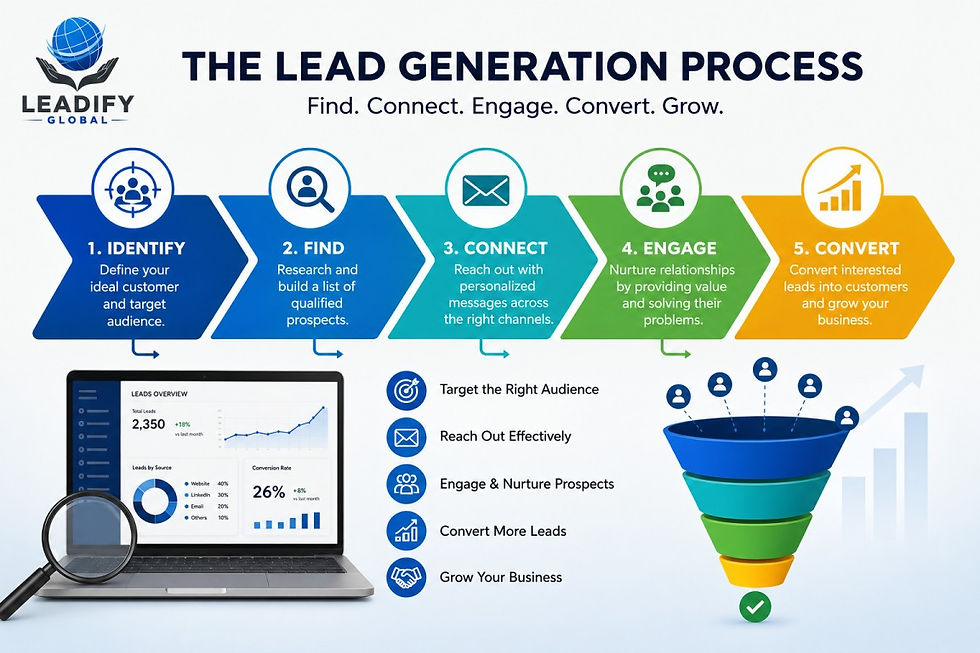
A practical lead-generation process can be divided into six stages:
Step 1: Define your audience
Identify your ideal customer profile and the decision-makers you want to reach.
Step 2: Build your prospect database
Find relevant companies and contacts that match your criteria.
Step 3: Verify your data
Check contact information before beginning outreach.
Step 4: Choose your channels
Select the channels where your prospects are most likely to respond.
These may include:
Email
LinkedIn
Phone
SEO
Paid advertising
Networking
Referrals
Step 5: Start outreach
Create personalized messages that focus on the prospect's needs instead of simply promoting your company.
Step 6: Measure and improve
Track which audiences, messages, and channels generate the best results.
Then improve the campaign based on actual data.
How Leadify Global Can Help Small Businesses Generate Leads?
Building a reliable prospect database can be one of the most time-consuming parts of lead generation.
Leadify Global helps businesses connect with targeted prospects by providing relevant lead data based on specific business requirements.
Our approach focuses on identifying prospects according to factors such as:
Industry
Location
Business type
Product or service requirement
Target market
Buyer profile
We provide relevant prospect information, including name, phone number, and business email ID, where available and appropriate, helping businesses spend less time searching for potential customers and more time converting opportunities.
Whether you are looking for B2B leads, business leads, buyer leads, or targeted prospects, the objective is the same: connect your sales team with people and businesses that are relevant to what you offer.
Common Lead Generation Mistakes Small Businesses Should Avoid
Even a good strategy can fail because of poor execution.
Avoid these common mistakes:
Buying random bulk databases
A large database doesn't necessarily mean a large number of opportunities.
Targeting everyone
Trying to sell to everyone often results in messaging that connects with nobody.
Sending generic messages
Prospects are more likely to respond when the message is relevant to their business.
Ignoring follow-ups
Many potential opportunities are lost because businesses stop following up too early.
Focusing only on volume
More emails, calls, or contacts don't automatically produce more customers.
Not tracking results
Without measuring conversions, it is difficult to know which lead generation strategies are actually working.
How Long Does It Take to Generate Leads?
There is no universal timeline.
Results depend on factors such as:
Industry
Target audience
Offer
Sales cycle
Marketing channel
Lead quality
Outreach quality
Budget
Follow-up process
Some channels can generate inquiries quickly, while SEO and content marketing generally require more time to build momentum.
The most important objective is to create a repeatable process and continuously improve it.
Final Thoughts
Learning how to generate leads for small business isn't about finding one magic marketing channel.
It's about building a system.
Start by defining your ideal customer. Build a targeted database. Verify your information. Choose the right channels. Create relevant messaging. Follow up consistently. Measure qualified opportunities and improve your strategy based on results.
Most importantly, don't confuse having more contacts with having more opportunities.
The right leads, reaching the right business, at the right time, can create a much stronger sales pipeline than simply chasing lead volume.
If your business needs targeted prospects to support its sales and marketing efforts, Leadify Global can help you identify and connect with relevant business leads based on your requirements.
Ready to find your next potential customers? Get in touch with Leadify Global and tell us what type of leads you're looking for.


Comments